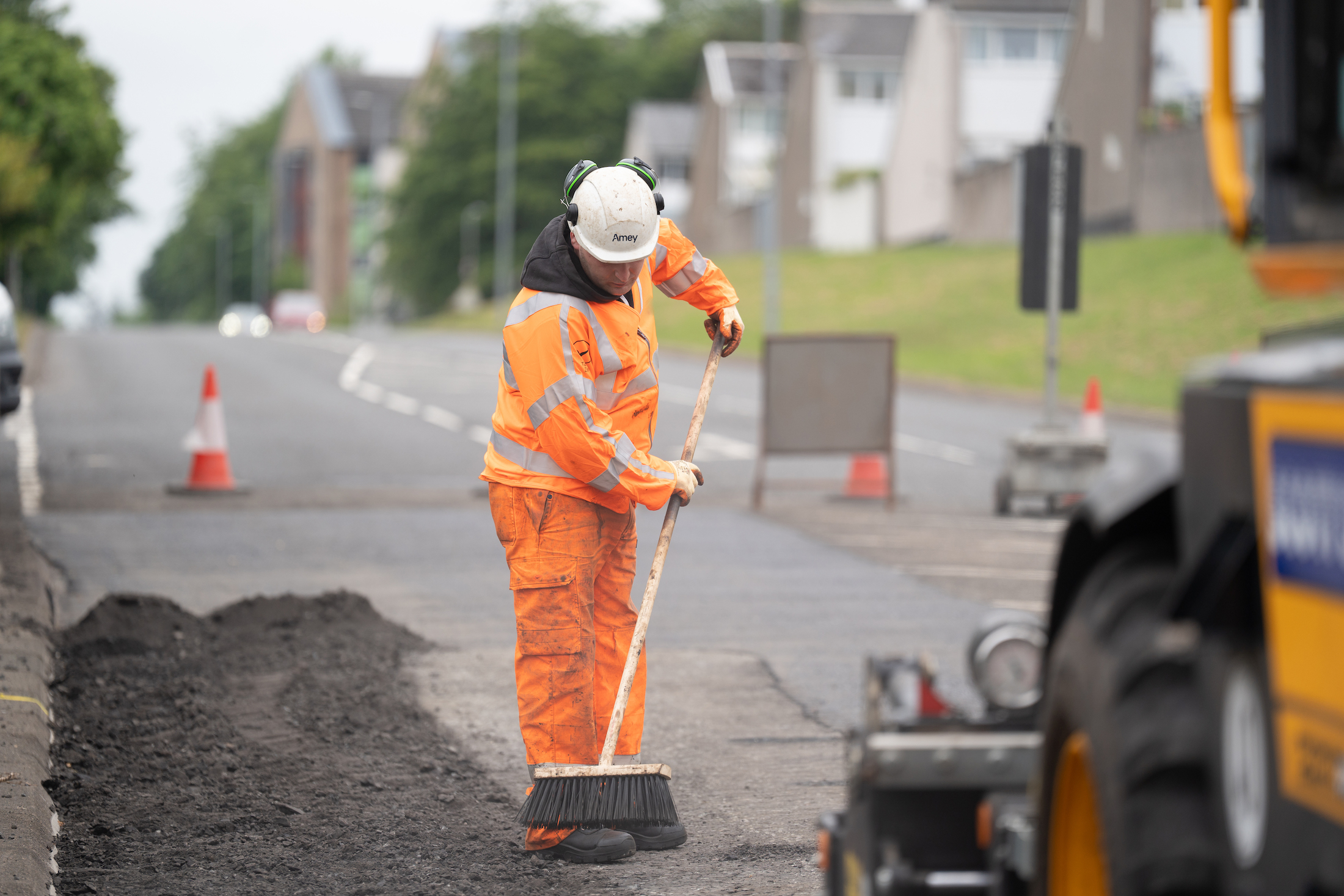
The council, supported by Amey, has delivered a Knowledge Bank, an open‑source digital platform giving local authorities access to carbon data, materials comparison tools and shared learning to help decarbonise road maintenance.
The platform marks a key milestone as the ADEPT Live Labs 2: Decarbonising Local Roads in the UK programme approaches the end of its three‑year delivery phase on 31 March 2026.
The £30 million, UK‑wide programme, funded by the Department for Transport, brings together seven projects grouped under four interconnected themes, each testing new ways to reduce the carbon footprint of local highway networks across their full lifecycle.
As one of these seven projects, the council, working with Amey, also led the North Campus of the Centre of Excellence for Decarbonising Roads (CEDR), collaborating with partners across Scotland and beyond to accelerate progress towards net‑zero local highways. The South Campus is led by Transport for West Midlands with support from Colas.
Over the past three years, the North Lanarkshire project has tested low‑carbon materials in live road maintenance environments, helping address technical, behavioural and market barriers that have slowed adoption across the highways sector. Working with local authorities, industry partners and Small-to-Medium Enterprises (SMEs), the project progressed from early research and materials evaluation to live operational trials, demonstrating how low‑carbon solutions can be deployed in real‑world conditions.
Comparative assessments showed carbon reductions of up to 58.12 per cent, equating to an estimated 108.1362 tonnes CO₂e saved across participating sites. These savings relate to lifecycle stages A1-A5, capturing cradle to construction carbon emissions, from raw material extraction to final on-site delivery. A sector‑leading comparative trial methodology introduced in 2024 provided robust data to help authorities confidently evaluate and adopt emerging low‑carbon materials.
Digital innovation played a central role through the Knowledge Bank, developed in partnership with Microsoft and Transparity. The platform allows councils and industry partners to access shared data, compare materials and draw on insights from the Live Labs 2 programme.
Alongside this, the Barriers to Decarbonising Roads Sandbox supported collaboration with SMEs to identify technical and regulatory challenges affecting innovation uptake, while behavioural research with Thinks Insight explored the cultural changes needed to embed low‑carbon practices across the sector.
The programme’s impact has been recognised nationally, with awards at Highways UK 2024 and the RSTA Awards 2025, as well as finalist recognition at the Scottish Transport Awards 2025.
Councillor Loughran, Convener of the Environment and Climate Change Committee, said: “Since declaring a climate emergency in 2019, the impacts of climate change have continued to intensify. This project has reinforced North Lanarkshire’s role at the forefront of innovation in the transport sector to address these challenges. By building strong partnerships across Scotland and beyond, we have helped create the foundations for the sector‑wide change needed to support net‑zero highways.”
Kyle Clough, Highways and Waste Collections Sector Director at Amey, added: “Live Labs 2 has shown what’s possible when innovation is tested in the real world. By working closely with North Lanarkshire Council and partners across the programme, we have helped turn research and insight into practical delivery. The tools, evidence and networks created through this work will continue to support the highways sector long after the programme concludes.”
Although the Live Labs 2 trials and delivery activity are concluding, the Department for Transport confirmed in January that the programme will receive a one‑year extension, providing up to £300,000 to support a dedicated phase of sector‑wide communications and dissemination.
This extension ensures that the insights, evidence and innovations generated across the seven Live Labs 2 projects are fully shared, scaled and embedded across the UK highways sector, helping local authorities adopt low‑carbon approaches with confidence and maximise the programme’s long‑term impact.